


Art Basel Hong Kong 2025
21 March – 25 March 2023
Booth
3D12
Encounter
EN9
ART BASEL HONG KONG 2023
| Booth: | 3D12 |
| Artist:
|
BOLOHO, CAO Xiaoyang, Luis CHAN, CHENG Tsai-Tung, QIU Shihua, Dashi NAMDAKOV, WANG Dongling,
XU Longsen and ZHENG Li |
Shanshui (‘mountains and water’) landscape painting is the art form that best captures the spiritual essence of Chinese culture. The classical imagination of “magic mountains” posits a realm for the spirit that is both transcendent and concrete, and over the past millennium Shanshui has represented an art that is simultaneously religious, escapist, romantic and intellectually fulfilling.
Like western religious art, Shanshui has undergone many permutations in contemporary times, but unlikely to go away. Today Shanshui is being explored from many new angles now that the world is faced with increasingly imminent environmental threats, which sharpens the awareness that virtual reality cannot replace the real world.
In Art Basel Hong Kong 2023, Hanart TZ Gallery brings together contemporary practitioners, including CAO Xiaoyang, Luis CHAN, CHENG Tsai-Tung, QIU Shihua, WANG Dongling, XU Longsen and ZHENG Li. Their work trace diverse developments of Chinese contemporary art, and illuminate important aspects of the subject of Shanshu.
A special feature of our booth this year is sculpture by Dashi NAMDAKOV. Nomadic art is fascinating for Asian cultures because nomadism is the alterity that defines agrarian culture, and it is often the challenge of nomadism that stimulates sedentary cultures with much needed spiritual sustenance. Historical Shamanism has barely survived modern times, and is now found only in isolated communities, but Dashi NAMDAKOV has always worked with shamanic themes drawn from his native Buryat nomadic roots. His sculptural forms give shape to the powers lying beyond humanity and the reach of civilisation.
In parallel with the current exhibition at Hanart TZ Gallery’s space in Kwai Chung, a 7-meter “screen painting” by BOLOHO is featured at Art Basel as a special highlight. This young collective of artists from Guangzhou recently exhibited at Documenta Fifteen. BOLOHO’s art reflects the cultural imagination of this generation of Guangzhou youth, which is interwoven with the memory of Hong Kong media and urban culture of the 2000s — the result of an early Open Policy between China and Hong Kong which privileged Guangdong Province before the opening of the rest of China.
Encounter: EN9
Constellation Forest by Inga Svala Thórsdóttir and Wu Shanzhuan

Working together since the early 1990s, Inga Svala Thórsdóttir and Wu Shanzhuan’s partnership reflects a symbiotic, creative dialogue. Their individual practices merge to reflect each other’s intellectual complexity and spiritual purity, with a polarity that is evident in this work. The wooden architecture offers the audience passage for activation. It is also a cosmic site for contemplation and intimacy. The artists invite you to move through the environment to experience it from alternative perspectives, both introspectively and alongside the pauses and transits of others. Questioning the very nature of being, the duo offers a sacred space for worship, or a place of meeting to reflect and breathe – inward and outward.
CAO Xiaoyang曹曉陽 (b. 1968, Jiangsu province, China)

Cao Xiaoyang’s innovative signature technique of highly intricate “painting”–using charcoal instead of the soft brush– endeavors to transcend the boundaries of traditional ink painting. Cao’s atmospheric, contemporary landscapes evoke the magic of ancient masters, and capture the spirit of nature treasured by artists over a millennium of landscape practice.
CAO often sketch outside in nature, facing the mountain at different times of the day, and watching as nature’s mysteries unfold one after the other, and then are hidden again, until gradually everything melds into one.
CAO’s exploration of Shanshu’ is not so much about the landscape itself, nor the historical experience of the art of Shanshui, but concerns a method of investigation and experimentation that maintains the awareness of and concern for this world, and for understanding life and the endless experiment of existence.
CAO Xiaoyang was born in 1968 in Zhenjiang, Jiangsu province. He is now the Deputy President of the China Academy of Art in Hangzhou. In 2014 Cao Xiaoyang had his debut solo exhibition The Twenty-Four Solar Terms at Hanart TZ Gallery in Hong Kong. In 2016 Cao was invited to participate in Beyond the Globe: Eighth Triennial of Contemporary Art—U3 in Slovenia, and in Shanshui: A Manifesta, the opening exhibition of the Gongwang Museum of Art in Hangzhou. In 2017 Cao had his major solo exhibition The Moments In-Between: Cao Xiaoyang’s Works on Paper at the China Academy of Art.
Cheng Tsai-Tung 鄭在東 (b. 1953, Taipei, Taiwan)

In recent years, Cheng Tsai-Tung has increasingly shifted to a state of solitude in which his interlocutors remain the ancients alone. Through classical poetry, he has slowly found ways to crystallize these complex sentiments into a faint personal melancholy. He condenses his personal tales and sensibility into the mise-en-scène of colourful moonlight, and at the same time morphs himself into a sentient being within the stream of history.
Cheng Tsai-Tung’s creative urge is driven by contemplative anxiety about the passing of time, and the fragility and preciousness of life. His pursuit of archaic style is a testament to his many years of research travels around China. Although Cheng Tsai-Tung refuses the traditional paths of ink painting, his persistent search for the archaic spirit has opened a personal approach. In these paintings, we can see his engaged interest in ink and brush, his relish in the charm of ‘awkwardness’ and ‘playfulness’, as well as the inner reserve of his personality that flashes out of the silence.
Cheng Tsai-Tung is one of an important group of Taiwan artists who first made their mark during the late 1970s and early 1980s. They sought contemporary forms of literati aesthetics via a unique mode of Expressionism, blended with subtle surreal imagery.
Cheng Tsai-Tung’s major recent exhibition was presented in 2019 at the Tofuku-ji Tempo in Kyoto, a temple built in 1236 by the imperial chancellor Kujō Michiie. The exhibition examined elements of traditional Chinese literati (scholar-artist) aesthetics and highlighted the way art engages with the exhibiting environment. He has been living and working in Shanghai since 1998.
Luis CHAN 陳福善 (1905-1995)

Of all the great first-generation Chinese modern masters, Luis Chan was perhaps the only one who fully faced up to contemporary culture and its challenges. Among those artists born in the twilight of the Qing Dynasty, master like Lin Fengmian and Xu Beihong, who also pursued Western style art, no one resonated more intimately with our time and place in history than Luis Chan.
Luis Chan (1905 – 1995) was born in Panama in 1905 to Cantonese parents who re-settled in Hong Kong in 1910. Largely self-taught, in his early years Chan was one of the most active ‘interpreters’ of western art through translating foreign art journals, writing criticism and organising exhibitions. Between the late 1920s and 1950s Chan developed a lively English landscape style, and became known locally as the ‘King of Watercolour’. His style evolved as the city went through a half-century of dramatic social cultural changes. By the late 1960s, his paintings started to emerge as dreamscapes that portrayed the subconscious life of the city and the psyche of the post-war generation.
Luis Chan was also a widely published art critic and writer, and a seminal catalyst in Hong Kong’s art circle. From his first solo debut exhibition in 1933 until his final show in 1993, Luis Chan presented 47 solo exhibitions over his long career and published countless articles on modern art.
Coinciding with the Hong Kong Arts Centre’s 45th anniversary in 2022, the Arts Centre created the flagship exhibition All the World’s A Stage: The Art of Luis Chan. A 5-year project “Luis Chan Studio” was also launched, with the studio replica showcasing the artist’s daily living space when he was still alive, allowing the audience to gain an in-depth glimpse into both Luis Chan and Hong Kong’s artistic world of his era.
Prior to this, in 2019, The Power Station of Art in Shanghai, China’s first state-run museum dedicated to contemporary art, presented a major retrospective exhibition for Luis Chan featuring more than 100 artworks.
QIU Shihua 邱世華 (b. 1940, Sichuan Province, China)

One enters Qiu Shihua’s paintings as if slipping into the morning mist. Whiteness dominates, shifting in a variety of shades. By pushing the contrast of form and colour to a minimum, even to the point where it can hardly be differentiated, Qiu has changed the act of viewing from an active solicitation to an alert envisioning. Yet, because his faintly painted landscapes cannot be discerned at a glance, it is necessary first to relax the mind before the image in the painting slowly floats into view: in this way a meditative state becomes the prerequisite condition for viewing the work. Eventually when the eyes make out the view: the vague fold of trees, and fainter woods afar, one magically seems to see, or sense, fine details invisible before, down to the play of light on the tufts of grassy fodder. Qiu’s paintings give the impression of entering the world at a moment of fullness when its mysteries are about to be revealed: light at daybreak, first darkness at dusk, or the moment when sound breaks the fullness of silence.
QIU’s major group exhibitions include the groundbreaking China’s New Art, Post-1989 (1993-1997), which debuted in Hong Kong and toured; China! at Kunstmuseum Bonn in Bonn, Germany (1996); the 23rd International Biennial of São Paulo (1996), where he participated in the main thematic exhibition and was awarded a major art prize; and the 48th Venice Biennale (1999).
Important solo exhibitions include Qiu Shihua, Kunsthalle Basel, Basel, Switzerland (1999); Landscape–Painting on the Edge of Visibility, Galerie Rudolfinum, Prague, Czech Republic (2000); White Field, a major retrospective at Hamburger Bahnhof, Berlin, Germany (2012); and Landscape, Light and Silence, Museum Pfalzgalerie Kaiserslautern, Kaiserslautern, Germany (2012).
Qiu Shihua graduated from the Xi’an Academy of Fine Arts in 1962, and currently lives and works in Beijing and Shenzhen.
WANG Dongling王冬齡 (b. 1945, Jiangsu province, China)
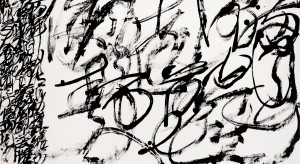
“Entangled Script” and “Calligraphic Paintings” are calligrapher Wang Dongling’s representative creations. Entangled Script is the culmination of Wang Dongling’s lifelong pursuit of an art that is both universal and Chinese, forward-looking, and firmly grounded in the past. Wang Dongling breaks away completely from the implied grid of traditional calligraphy, interweaving individual characters and entire columns into an amorphous field. The calligraphic lines take flight in their variations in texture and rhythm, and yet remain tenuously tethered to the text as musical performance is to score and meter.
Wang’s work has been featured in museum exhibitions internationally, including China: Five Thousand Years (1998), Solomon R. Guggenheim Museum New York; Brushes with Surprise: The Art of Calligraphy in Modern China (2002), British Museum; Brush and Ink: The Chinese Art of Writing’ (2006), Metropolitan Museum of Art; Lanting Pavilion Review: China Calligraphy Exhibition (2010), Royal Museums of Fine Arts of Belgium, Brussel.
Wang’s recent solo exhibitions include The Art Institute of Chicago (2018); Wang Dongling: The Bamboo Path, OCAT Shenzhen (2017); Between Heaven and Heart: Wang Dongling’s Calligraphy, Imperial Ancestral Temple Art Museum, Beijing (2016).
Wang is also acclaimed for his calligraphy performances, events including: British Museum (2016); Victoria and Albert Museum (2016); Imperial Ancestral Temple Art Museum, Beijing (2016); Vancouver Art Gallery (2016); Brooklyn Museum (2015); Universität Hamburg, Germany (2015); Metropolitan Museum of Art (2014); City University of Hong Kong (2013); Hong Kong Museum of Art (2013).
He is currently a Professor in the Calligraphy Department of the China Academy of Art (CAA), and Director of CAA’s Contemporary Calligraphy Research Centre.
XU Longsen 徐龍森 (b. 1956, Shanghai, China)

Xu Longsen’s key contribution to landscape painting is in his concept of ‘monumental ink,’ which represents the artist’s unique approach to challenging the physical space of the exhibition hall and opening up unprecedented vistas that break through traditional boundaries of Shanshui art.
In 2018 spring, the Art Institute of Chicago presented a large exhibition for Xu Longsen, Light of Heaven, marking the first solo exhibition of contemporary ink painting of the Art Institute. For his site-specific installation, Xu created a visual dialogue with the architecture, evoking a sense of aesthetic and physical fusion.
Xu Longsen’s landscapes challenge the monumentality of modern architecture with their imposing presences. His painting installations include the Palace of Justice in Belgium (2009) and the Museum of Roman Civilization in Rome (2011). His position within the lineage of Chinese landscape tradition was recognized in the invitation by the Nelson-Atkins Museum of Art in 2013 when he was invited to exhibit together with the museum’s famous collection of masterwork paintings from the 10th to 18th century.
Xu Longsen was born in Shanghai in 1956, and graduated from the Shanghai Arts and Crafts College in 1976. He currently lives in Beijing.
ZHENG Li 鄭力 (b.1964, Ningbo, Zhejiang Province, China)

ZHENG Li’s artistic vision is articulated through the juxtapositions between the contained beauty of the classical garden and the vastness of nature which they encapsulate. The artist’s supremely mastery of brushwork allows him to create unique innovations within the lineage of the ink-painting language, making his art part of a contemporary evolution of Chinese Shanshui painting rather than a subversion of it.
ZHENG’s work conjures a sense of intriguing duality, of both reality and illusion, like the reflection of the moon in water or a flower glowing in a distant garden, bringing into being a world that draws upon the viewer’s own mood and sensibility as its own setting.
ZHENG Li received both his BA (1988) and his MA (2004) from the China Academy of Art, Hangzhou (CAA). Since 1994 he has been teaching in CAA’s Chinese Painting Department.
Zheng Li’s major exhibitions include SHANSHUI A MANIFESTA at Gongwang Art Museum in Hangzhou (2016), One Hundred Years of Chinese Painting at the National Art Museum of China in Beijing (2001), and in China’s prestigious National Exhibitions of Fine Arts where his works have won numerous prizes. His paintings are highly sought after and are in several private and museum collections.
Dashi NAMDAKOV 達西.那姆達科夫 (b. 1967, Ukurik village, Chita region)

Technological advancement of this era has spurred a fascination with archaic magical powers; witness the revival of gothic imagination in graphic art and novel fascination with zombies and aliens in popular cinema. Historical Shamanism has barely survived modern times, and is now found only in isolated communities; but Dashi Namdakov has worked with shamanic themes drawn from his native Buryat nomadic roots, and his sculptural forms give shape to the powers lying beyond humanity and the reach of civilisation.
Dashi Namdakov was born in 1967 in a small Buryati village near the Russian–Chinese border, near the magnificent Lake Baikal, the world’s cleanest and biggest freshwater container, a World’s Natural Heritage Site. The local people – Buryats – believe the Lake to be sacred. Dashi graduated from the sculpture department of the Krasnoyarsk State Art Institute in 1992, and since 2000 has exhibited worldwide, from Tokyo and Beijing to New York and Los Angeles.
Dashi Namdakov’s works are in public collections of the State Hermitage, the Ethnographic Museum in St. Petersburg, the Moscow Museum of Modern Art, the State Museum of Oriental Art. Private collections include USA, Germany, France, Great Britain, Belgium, Switzerland, Japan, China and Singapore.
Special Highlight: BOLOHO 菠蘿核 (Artist Collective found in 2019, Guangzhou, China)

In parallel with the current exhibition at Hanart TZ Gallery, a 7-meter “screen painting” by experimental Guangzhou art collective BOLOHO is featured at the Art Basel Hong Kong 2023. This work is one of the screen paintings made for their recent project BOLOHOPE (in collaboration with “Reading Room”), as featured in Documenta Fifteen in 2022.
BOLOHO’s works reflect the cultural imagination of this generation of Guangzhou youth, which is interwoven with the memory of Hong Kong media and urban culture of the 2000s—the result of an early Open Policy between China and Hong Kong which privileged Guangdong province before the opening of the rest of China.
ENCOUNTER E9 at Art Basel:
Inga Svala THÓRSDÓTTIR & WU Shanzhuan 吳山專 與 英格ㆍ斯瓦拉ㆍ托斯朵蒂爾

Constellation Forest is a series of arches constructed by the principle of the perfect bracket and little fat flesh, forms that echo, and pay homage to the ancient tradition of sacred geometry. But their geometry refers to impossible forms that can only belong to transcendent metaphysical spaces. Wu claims: “The very fact that thought has to produce visible evidence spells out its tragedy, for truth has been murdered by its medium.” Here lies the irony for the visual artist, whose very task should be the ideal Platonic Form. It is from this ironic position Inga and Wu launch their radical critique of modernity, which includes the artwork Things’ Rights that subverts the 30 Articles of “Human Rights” by expanding these principles from humans to all “things”, and exposes with humour the anthropocentric prejudice of the Enlightened modern man. The arches of the Constellation Forest invite the visitor to stand under a space where he or she may speculate upon the task of art-making as world-creation.
Inga Svala Thórsdóttir was born in Iceland in 1966. She graduated in 1991 from the Painting Department of the Icelandic School of Arts and Crafts, and in 1995 from the Hochschule für bildende Künste in Hamburg. In 1993 she founded Thor’s Daughter’s Pulverization Service, and in 1999 she founded BORG.
Wu Shanzhuan was born in China in 1960. He graduated from the Zhejiang Academy of Fine Arts in 1986, and in 1995 from the Hochschule für bildende Künste in Hamburg. In 1985 he founded Red Humour, and in 1990 he founded Red Humour International.
Since 1991 Thórsdóttir and Wu have been working and exhibiting collaboratively. They live and work in Hamburg, Shanghai and Reykjavík.

Dashi NAMDAKOV
Memory of the Future
2001
Bronze, Cast and Patinated
77 x 53 x 33 cm
Edition of 15 + 4AP

Dashi NAMDAKOV
Yin-Yang
2001
Bronze, Cast and Patinated
85 x 153 x 38 cm
Edition of 15 + 4AP

Dashi NAMDAKOV
Levitation
2011
Bronze, Cast and Patinated
85 x 153 x 38 cm
Edition of 8 + 4AP

DASHI NAMDAKOV
She-Guardian
2003
Bronze, Cast, and Patinated
116 x 28 x 30 cm
Edition of 15 + 3FP

WANG Dongling
Xun Mu (Flexibility)
2016
Ink on Paper
96 x 178 cm

WANG Dongling
YAN Shu, ‘Sandy Creek Washers’, Entangled Script
2016
Ink on Paper
96 x 178 cm
Image courtesy of the artist

XU Longsen
Cloud Series No. 3
2015
Ink on Paper
122 x 122 cm
Image courtesy of the artist

XU Longsen
Cloud Series No. 10
2015
Ink on Paper
122 x 122 cm

BOLOHO
BOLOHOPE No.3
2022
Acrylic and textile on canvas
200 × 700 cm

CAO Xiaoyang
THE TWENTY-FOUR SOLAR TERMS : Vernal Equinox
2011
Charcoal on Paper
80 x 120 cm

CAO Xiaoyang
THE TWENTY-FOUR SOLAR TERMS : Summer Solstice
2010
Charcoal on Paper
78.5 x 110 cm

Cheng Tsai-Tung
Pavilion In a Moutain Lake
2022
Acrylic on canvas
200 x 200cm

Cheng Tsai-Tung
A Private Studio
2021
Acrylic on canvas
200 x 200cm

QIU Shihua
Landscape 1999.4
1999
Oil on Canvas
242 x 388.5 cm (Triptych)

Luis Chan
Untitled (Man with Saw-teeth)
1969
Acrylic on Paper
76 x 153 cm

ZHENG Li
Jade River
2022
Ink and Colour on Paper
68.5 x 181.5 cm

Inga Svala Thórsdóttir & Wu Shanzhuan
Constellation Forest
2018
American Pine, Larch, Hemlock,and White Pine
Approx. 330 x 900 x 500 cm