


香港巴塞爾藝術展
Art Basel Hong Kong
Booth 3D08
冰逸 Bingyi
胡項城 HU Xiangcheng
菠蘿核 BOLOHO
陳福善 Luis CHAN
葉世強 YEH Shih-Chiang
2026 3.25-29
香港會議展覽中心
HK Convention & Exhibition Centre, Wan Chai
Encounter: Inga Svala THÓRSDÓTTIR & WU Shanzhuan 吳山專 與 英格ㆍ斯瓦拉ㆍ托斯朵蒂爾
Encounter: EN9
Working together since the early 1990s, Inga Svala Thórsdóttir and Wu Shanzhuan’s partnership reflects a symbiotic, creative dialogue. Their individual practices merge to reflect one artist’s complexity and the other’s purity, with a polarity that is evident in this work. The wooden architecture offers the audience passage for activation. It is also a cosmic site for contemplation and intimacy. The artists invite you to move through the environment to experience it from alternative perspectives, both introspectively and alongside the pauses and transits of others. Questioning the very nature of being, the duo offers a sacred space for worship, or a place of meeting to reflect and breathe – inward and outward.


Constellation Forest is a series of arches constructed by the principle of “the perfect bracket” and “little fat flesh”, geometric forms the artists invented as a homage to Plato. But their geometry refers to impossible forms that can only belong to transcendent metaphysical spaces. Wu claims: “The very fact that thought has to produce visible evidence spells out its tragedy, for truth has been murdered by its medium.” Here lies the irony for the visual artist, whose very task should be the ideal Platonic form. It is from this ironic position Inga and Wu launch their radical critique of modernity, which includes the artwork “Things’ Rights” that subverts the 30 Articles of “Human Rights” by expanding these principles from humans to all “things”, and exposes with humour the anthropocentric prejudice of the Enlightened modern man. The arches of the “Constellation Forest” invite the visitor to stand under a space where he or she may speculate upon the task of art-making as world-creation.
The radicality of their approach to art-making is impressive, which perhaps reflects the context of their backgrounds. For Inga whose home is Iceland, one speculates on the utopic constitution of Iceland’s geography and its intimate society. For Wu whose home is Zhoushan Island near Shanghai, one cannot but be reminded of the radical experimentation of Mao’s politics. Wu grew up in the turbulent years of the Cultural Revolution when an adolescent believed every aspect of the social world could be challenged and the human being transformed.
Inga Svala Thórsdóttir was born in Iceland in 1966. She graduated in 1991 from the Painting Department of the Icelandic School of Arts and Crafts, and in 1995 from the Hochschule für bildende Künste in Hamburg. In 1993 she founded “Thor’s Daughter’s Pulverization Service”, and in 1999 she founded “BORG”. Wu Shanzhuan was born in China in 1960. He graduated from the Zhejiang Academy of Fine Arts in 1986, and in 1995 from the Hochschule für bildende Künste in Hamburg. In 1985 he founded “Red Humour”, and in 1990 he founded “Red Humour International”. Since 1991 Thórsdóttir and Wu have been working and exhibiting collaboratively. They live and work in Hamburg, Shanghai and Reykjavík.

Taipei Nangang Exhibition Center, Hall 1 (4th Floor)
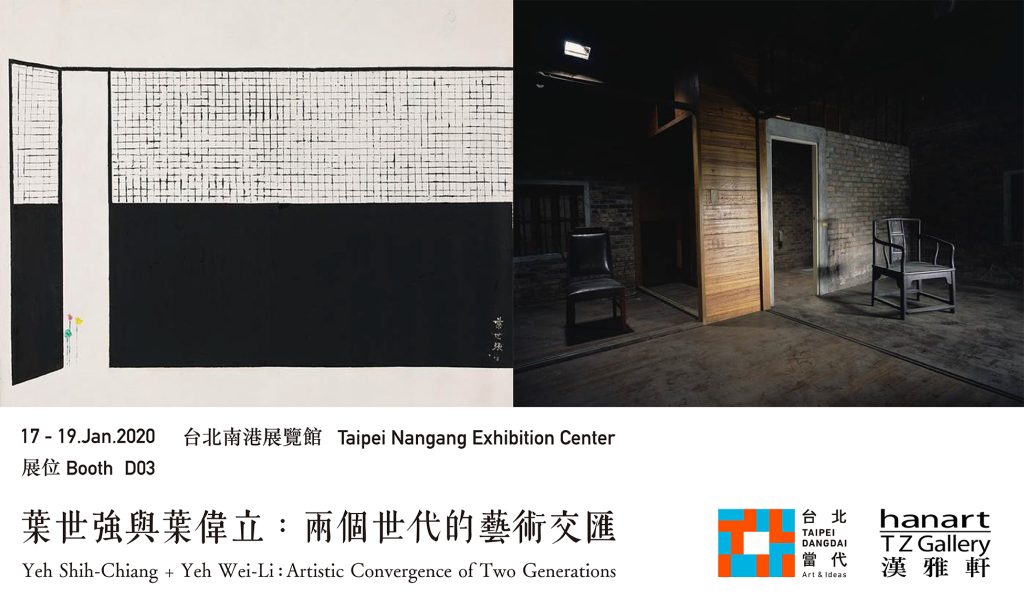
Hanart TZ Gallery|Taipei Dangdai
Yeh Shih-Chiang + Yeh Wei-Li: Artistic Convergence of Two Generations
Venue|Taipei Nangang Exhibition Center, Hall 1 (4th Floor)
No. 1, Jingmao 2nd Road, Nangang District, Taipei City
Booth|D03
VIP Preview (invitation only)|2pm-5pm, Thursday, 16 January
Vernissage (by invitation or advance ticket)|5pm-9pm, Thursday, 16 January
Public Opening|
11am-6pm, Friday, 17 January
11am-6pm, Saturday, 18 January
11am-5:30pm, Sunday, 19 January
Yeh Wei-Li’s “on-site archeology” turns artistic practice into research methodology. Through imaginative engagement he breathes new life into the “historical remains” of the life and art of Yeh Shih-Chiang (1926-2012). The reconstruction of Yeh Shih-Chiang’s former home in Shuinandong into a “residence museum” will be completed in the middle of this year. It is while living in this house, located in an old gold mining village at the foot of Mt Jiufeng and looking east towards the Pacific Ocean and Guishan Island, that Yeh Shih-Chiang developed his artistic conception that was to inform his creative work in the second half of his long life. This former residence of Yeh Shih-Chiang will now become a cultural and geomantic pulse point in the northeastern corner of Taiwan.
A major new publication on the project, Yeh Shih-Chiang + Yeh Wei-Li, will be launched at the Art Fair. The transmission of artistic illumination between generations is the creative methodology Yeh Wei-li uses in exploring the cycles of history and the operating mechanisms of social change.
Yeh Shih-Chiang was born in 1926 into a scholarly family in Shaoguan, Guangdong Province, China. During his student years at the Guangzhou College of Art, Yeh was granted permission by the influential artist Gao Jianfu, then Principal of the College, to take leave from his studies and set out on an adventure to travel and sketch along the way. With the intensification and spread of China’s Civil War, Yeh was forced to abort his plans and redirect his route to Taiwan. Unexpectedly, Yeh became stranded in Taiwan at the end of the war, when travel between Taiwan and the mainland was cut off. During his first few years in Taiwan, Yeh studied art at the Taiwan Provincial Teachers’ College (now National Taiwan Normal University) in Taipei. Depressed by his isolation from his homeland, Yeh grew increasingly reclusive and secluded himself in the countryside, where he lived a simple, ascetic life, practicing Zen Buddhism, teaching and painting. Gradually Yeh planted both creative and spiritual roots for himself in Taiwan, and every aspect of his daily activities was informed by a conscious awareness of the ideal of inner cultivation shared by both the Chinese literati and Zen traditions.
Contemporary artist Yeh Wei-Li was born in Taiwan in 1971. Since 2015, he has been engaged in a process of gradually and painstakingly excavating the history and environments of Yeh Shih-Chiang’s life as a means of understanding the personal and creative archaeology of the artist himself. His journey has taken him from Yeh Shih-Chiang’s abandoned residence in the remote village of Wan Tong in Xindian County to the master’s former home in the northeastern seacoast town of Shuinandong, on a path to unearth and re-examine the traces of Yeh Shih-Chiang’s world. Yeh Wei-Li’s series of photographic works taken over this period reveals a process akin to preparing and plowing the soil, planting the seeds and waiting patiently for them to grow, without expectation, until suddenly a new kind of illumination appears. In 2019 Yeh Wei-Li began to build wooden frames for Yeh Shih-Chiang’s oil paintings, as an act of homage to the master and a way of creating new possible perspectives through which to approach his works.

Press Enquiries
E. hanart@hanart.com
T. +(852) 2526 9019
1901 Convention Center Drive Miami Beach, USA

Solo Presentation
of
XU Longsen
at
Art Basel Miami Beach
with
Moon Jar by Young Sook PARK
Booth No.: N7, HANART TZ GALLERY
Venue: 1901 Convention Center Drive, Miami Beach, USA
Date: December 5-9, 2018
In spring 2018, the Art Institute of Chicago presented XU Longsen’s solo exhibition “Light of Heaven”, marking their first exhibition of contemporary ink art.
At Art Basel Miami Beach 2018, Hanart TZ Gallery is pleased to present a collection of works by XU Longsen (徐龍森 b. 1956, Shanghai, China) that further explore the artist’s key contribution to the evolution of landscape art. XU’s own concept of ‘monumentality,’ which is deeply immersed in China’s painting tradition, at the same time he brings to it a sense of grandeur and time immemorial. His monumental installations have been exhibited to great acclaim at the Palace of Justice in Belgium (2009), Museum of Roman Civilization in Itay (2011), Nelson-Atkins Museum of Art in USA (2013), and the Manarat Al Saadiyat in UAE (2015).
Hanart TZ Gallery is also proud to feature a majestic “Moon Jar” by celebrated ceramic master Young Sook PARK (朴英淑 b. 1947, Kyongju, Korea).
PARK’s versatility and precision reflect long-lost artistic traditions infused with a contemporary aesthetic, evidence of her unyielding efforts to challenge the technical boundaries governing both clay and glaze. Her work is in the permanent collection of Asian Art Museum of San Francisco, Philadelphia Museum of Art, Harvard Museum of Art, Seattle Art Museum, Victoria and Albert Museum, and British Museum of Art, etc.
Press Enquiries
E. hanart@hanart.com
T. +(852) 2526 9019
/spacer

Booth: N111, West Bund Art Center, Shanghai
VIP Preview: Wednesday, 7 November 2018
Public Days: Thursday, 8 November 2018 – Sunday, 11 November 2018
Venue: West Bund Art Center, Shanghai
Booth: N111
Artist: Xu Longsen
This past spring the famed Art Institute of Chicago held a major solo exhibition for Xu Longsen, marking an important milestone in the presentation of contemporary Chinese ink landscape art in the United States. At West Bund Art & Design 2018, Hanart TZ Gallery is pleased to present works by Xu Longsen that further explore the way the monumental landscape art of this modern master creates a completely new method of display within a contemporary architectural context.
Xu Longsen is renowned for his unique approach to melding the vocabulary of traditional ink painting into the language of contemporary art. Breaking through the spatial limitations of the traditional manner of display and challenging architectural space, Xu Longsen opens up limitless new possibilities for the future of ink ar
About Xu Longsen
Xu Longsen’s art underscores the continued relevance of shanshui (Chinese ink landscape) painting in the contemporary world, and the monumentality and layered delicacy of his vistas offer a new realm of encounter for a contemporary audience.
Xu Longsen’s landscapes challenge the monumentality of modern architecture with their imposing presences. His monumental installations, recently shown at the Museum of Roman Civilization in Italy (2011) and the Palace of Justice in Belgium (2009), astonished viewers with their breathtaking effects that seem to challenge the edifices of architecture with natural peaks that burst through the confines of manmade space. The sublimity hinted at by Chinese classical landscapes here manifests itself in physical presence.
Xu’s art is both a radical departure from, and an homage to, the past. His position within the lineage of this important tradition was recognized in the invitation by the Nelson-Atkins Museum of Art in 2013 when he was invited to exhibit his immense horizontal landscape together with the museum’s famous collection of masterwork paintings from the 10th to 18th century.
In Spring 2018, the prestigious Art Institute of Chicago presented Xu Longsen’s solo exhibition Light of Heaven (February through June 2018), marking the first time the Art Institute has presented an exhibition of contemporary ink painting. Xu’s massive installation consists of a set of pillars molded from felt and painted with layers of ink wash, along with a number of breathtaking landscape paintings—all inspired by the mythological Mount Kunlun, home to many Chinese gods and goddesses. With this site-specific installation, Xu again creates an impressive dialogue with the architecture of the site of display, evoking a sense of aesthetic and physical fusion.
Xu Longsen was born in Shanghai in 1956, and graduated from the Shanghai Arts and Crafts College in 1976. He currently lives in Beijing.
Press Enquiries
E. hanart@hanart.com
T. +(852) 2526 9019
Booth: J1-J3, Hall 3, Hong Kong Convention and Exhibition Centre

Private Preview and Vernissage: Friday, 28 September 2018
Exhibition Period: Saturday, 29 September 2018 – Tuesday, 2 October 2018
Venue: Hong Kong Convention and Exhibition Centre, Hall 3
Booth: J1-J3
Artist: Cao Xiaoyang
Hanart TZ Gallery is proud to present Cao Xiaoyang’s solo exhibition at Ink Asia 2018.
Cao Xiaoyang’s unique practice explores the possibilities of charcoal on paper to create intricate, atmospheric images of the world of shanshui (Chinese landscape art). Cao’s exhibition at Ink Asia will feature outstanding works created over the last decade, including his newest work, a monumental scroll measuring 2.5 metres in height, completed in 2018.
About Cao Xiaoyang
Cao Xiaoyang was born in 1968 in Zhenjiang, Jiangsu province. He received both his BFA (1994) and MFA (2002) from the Printmaking Department and is currently the Head of The Foundation Studies Branch of the China Academy of Art in Hangzhou. In 2014 Cao Xiaoyang had his debut solo exhibition The Twenty-Four Solar Terms at Hanart TZ Gallery in Hong Kong. In 2016 Cao was invited to participate in Beyond the Globe: Eighth Triennial of Contemporary Art—U3 in Slovenia, and in Shanshui: A Manifesta, the opening exhibition of the Gongwang Museum of Art in Hangzhou. In 2017 Cao had his major solo exhibition The Moments In-Between: Cao Xiaoyang’s Works on Paper at the China Academy of Art.
Artist’s Statement
For me, shanshui involves two different layers of investigation and two different types of work.
My art can be divided into two categories: the first comprises realist paintings from nature; and the second, paintings from memory, a ‘mnemonic’ of shanshui. When creating a realist landscape painting, I often spend three to four days sketching outside in nature, facing the mountain at different times of the day, and watching as nature’s mysteries unfold one after the other, and then are hidden again, until gradually everything melds into one. As the clouds gather and the mists spread, the composition of the mountain undergoes myriad transformations; it is full of an endless vitality. But this sense of endless vitality does not refer to the form of the mountain within the overall landscape, but rather to the way the plants and grasses are able to flourish and grow, and all myriad things to follow a divine pattern of life. And so the exploration of ‘shanshui’ is not so much about landscape itself, or the historical experience of shanshui painting. For us—for whom there is no path of return to the primeval—shanshui is more than just a cultural signifier or an iconic form; rather, it is a method of investigation and experimentation for maintaining awareness of and concern for this world, and for understanding life and the endless experiment of existence.
The ‘Twenty-four Solar Terms’ are the coordinates between man, heaven and nature. The myriad changes of the four seasons guide us towards a way of understanding life and the endless cycle of being. Most of my artwork unfolds from within the thematic context of the Twenty-four Solar Terms, expressing my thoughts and observations about the inter-relatedness of life in the human and natural worlds. The attitude and creative methodologies of my art are also my way of responding to the theatre of shanshui, where life’s myriad performances unfold in our world.
(Translation by Valerie C. Doran)
Press Enquiries
E. hanart@hanart.com
T. +(852) 2526 9019
Booth T7, Hall 2.1 Messe Basel, Messeplatz 10, 4005 Basel, Switzerland
Art Basel 2018
Booth T7, Hall 2.1
WEST HEAVENS: Nilima Sheikh and Qiu Zhijie
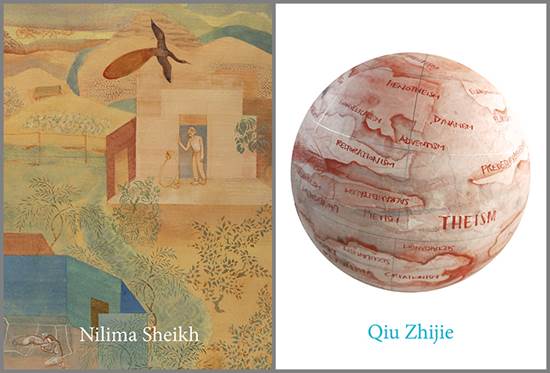
The exhibition recalls China’s ancient reference to India as the ‘West Heavens’, presenting a visual dialogue between India and China. The evoked imagination of unified national culture and its relationship with a dominant international sphere has characterised many aspects of political, technological, cultural and artistic histories.
Private Days
June 12-13, 2018, 11am to 8pm
Public Days
June 14-17, 11am to 7pm
Venue
Messe Basel, Messeplatz 10, 4005 Basel, Switzerland
Nilima Sheikh

Born in Delhi in 1945, Nilima Sheikh is one of India’s most celebrated artists. Over the last five decades, Sheik’s oeuvre has embraced multiple universes, composed in a unique visual language drifting between human journeys, landforms, and states of belonging. Her practice above all reflects a strong feminist commitment ato representing the many facets of womanhood, in the realms of the sacred and the biographical, and as a social subject. She utilizes a variety of media and techniques, including paper, installations, large scrolls and screens, illustrations for children’s books, and theatre set designs. First exhibiting her work 1969, Sheikh has participated in numerous exhibitions world wide, including most recently documenta 14 (Athens and Kassel, 2017).
Qiu Zhijie
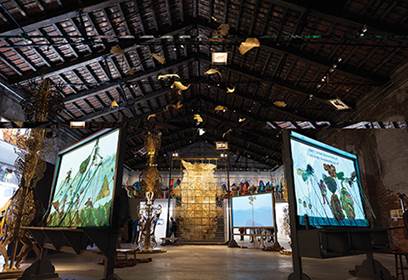
Born in Fujian Province, China, in 1969, Qiu Zhijie has created a formidable career and presence as a multidisciplinary artist, critic and curator. The encyclopaedic vision Qiu brings to his imaginative mappings of the human world, creating fantastic mind-scapes crossing categories cultural, political, institutional and more, open up systems of knowledge that invite the participation of all imaginative minds. Qiu’s recent projects include his curation of the Chinese Pavilion of the 57th Venice Biennale in 2017, and his commissioned project for the Solomon R. Guggenheim Museum in New York, for which he created a site-specific six-panel map as part of the exhibition Art and China after 1989: Theater of the World. Qiu is also currently a professor at the Central Academy of Fine Arts in Beijing, one of the country’s most prestigious art academies.
Hanart TZ Gallery
+852 2526 9019 hanart@hanart.com www.hanart.com
Press Enquiries
E. hanart@hanart.com
T. +(852) 2526 9019
Manarat Al Saadiyat, Saadiyat Cultural District, Abu Dhabi
MEMORY OF PLACE
Works by QIU Shihua, ZHENG Li, FENG Mengbo, and SHAGDARJAV Chimeddorj
Modern & Contemporary Sector: X3-03
Artists: QIU Shihua, ZHENG Li, FENG Mengbo, SHAGDARJAV Chimeddorj
Exhibition Period: 8 – 11 November 2017
Venue: Manarat Al Saadiyat, Saadiyat Cultural District
Exhibition Description
This exhibition of paintings and objects depicting different insights into the world of nature, by a diverse of group contemporary artists across generations and media, illuminates important the enduring power of landscape as a source of creative inspiration.
For our booth at the Abu Dhabi Art fair, Hanart TZ Gallery has curated a special exhibition featuring the work of three powerful Chinese contemporary artists and one of Mongolia’s most outstanding contemporary artists. These include the pastoral landscapes of QIU Shihua, the meditative gardens of ZHENG Li, the digital landscape paintings using classical tempera base by FENG Mengbo, and the inspiring, wide vistas of SHAGDARJAV Chimeddorj. Each artist’s work in its own distinctive way illustrates how a heightened awareness of one’s own inner experience of the world may arise from the quiet appreciation of nature. For each artist, nature is both a realm of experience and a locus of memories of place.
Special Project
Hanart TZ Gallery is also pleased to announce that, at the invitation of the Department of Culture and Tourism, artist FENG Mengbo has collaborated on a special project with Khalifa University, a leading technology university in the United Arab Emirates, connecting students further with art and encouraging creative experiment in the integration of art and science. In a one-week workshop taking place in mid-October this year, Feng Mengbo guided the students in extensive research into sound and the use of the oscilloscope as a creative visual instrument. In the final project, minimalist electronic music was composed and fed into a hardware oscilloscope, generating beautiful abstract moving images on a live feed, projected through video. Laser technology has inspired Feng’s concept of presenting the sensation of meditation through an electronic art form, and as Feng stated, ‘the compositional structure of the soundscape was inspired by the great spirit of Arabian traditional music and calligraphy.’
The finished work will be displayed at the Abu Dhabi Art fair in November 2017.
Press Enquiries
E. hanart@hanart.com
T. +(852) 2526 9019
Moderna galerija (MG+), Museum of Contemporary Art (+MSUM), Ljubljana, Slovenia
Beyond the Globe | 8th Triennial of Contemporary Art – U3
Curator: Boris Groys

Opening: 3 June 2016 at 8 p.m., Moderna Galerija
Venues: Moderna galerija (MG+), Museum of Contemporary Art (+MSUM) Ground Floor, Reactor Center Podgorica(Podgorica pri Ljubljani)
The exhibition presents many possibilities for the artistic exploration of the topic at hand: the connection between artistic and scientific imagination, the cosmos as analysis of sci-fi culture, perspectives of corporeal immortality and critique of contemporary technology. Slovenia’s art and artistic culture has always been particularly open to the universalist perspective. Already the architecture of Jože Plečnik signalled a desire to find a point of contact not only with world history but also with the mystical and mythical components of cosmic life – and at the same time to do so in an absolutely modern way. One cannot overlook the attachment of many Slovene artists, including many younger artists, to the utopian vision of Malevich and, in general, the early Russian avant-garde. This vision still informs many Slovene art practices – especially when it is referenced in a critical, ironic, or absurdist way.
The 8th edition of U3 brings an important change: it takes the exhibition outside the national framework. The new concept of U3 focuses on a dialogue between Slovene space and other contexts that are relevant for it. In this it follow the good practice of certain established “peripheral” biennials that focus on their specific time and place and function as a platform for produced meanings and contents with long-term, positive effects on their spaces.
For more details and images:
https://www.facebook.com/Hanart.TZ.Gallery/photos/?tab=album&album_id=1082604535133096
“Yaji Garden: Art Under the Sky”: a project in 4 parts.
Curators: CHANG Tsong-Zung, GAO Shiming
A.“Mountain and Water”
video (12 minutes)Artist (Garden Design): YE FangVideo: YANG Kai, GUO Yilin, Photography: Camille CHEN 陳雪, Sound: ZENG Yongqiang 曾永強

The Yaji Garden is both a garden for art gathering and domestic pleasure; its aesthetics is based on the same principle as the art of “mountain and water” painting (landscape). Artist YE Fang is a landscape painter affiliated with the Suzhou Painting Academy, and a specialist in classical gardens.
B.“Story of the Stone: Chiseling At Emptiness”
5 paper scrolls and one papier mâché sculpture, displayed as a constellation.5 paper scrolls (Right to Left): CAO Xiaoyang, LEUNG Kui-ting, LIN Haizhong, WANG Dongling, CHIU Kwong-chiuPapier mâché sculpture: XU Longsen

“Story of the Stone: Chiseling At Emptiness“ Concept by CHIU Kwong Chiu
Emptiness is not Void; it is the realm of potentiality. The Stone, or a drawing of the stone, emerges from emptiness to bring to life an ‘aesthetic realm’ by becoming part of a cosmos. A stone can merge with other stones to form a majestic mountain, or remain anonymous in the wilderness. Legend has it that the universe was formed when the goddess Nu Wo mended Heaven with a five-colour stone.
Paper comes from wood, a growing material that complements and ‘adds’ to the potentiality of Emptiness. The Stone represents the condensation of matter; its presence ‘reduces’ the potentiality of Emptiness. The calligraphic line draws the Stone as well as the Word; the line untangled undoes both the Stone and the calligraphic Word. In this constellation, scrolls, stones and ‘word-knots’ come together in various states of potentiality.
C.”Illuminated Presence”
An installation consisting of one painting, 3 photographs and 2 vitrines.
Artist (photography and installation): YEH Wei-liArtist (painting): YEH Shi-Chiang (1926-2012)

2008 Ink on Paper 136 x 420 cm


YEH Wei-li believes the practice of photography should be an active engagement with its subject matter. For this project he has renovated the old master’s derelict studio in order to bring it back to life for a series of photographs. He also selects and archives objects from the painter’s “relics” to give him a new “museum” presence.
D.”Eaves Dropping on A Tree Spirit”
Scroll in Moon Palace paper (20-meter roll)
Artist: Ali VAN


Artist Statement:
Les Titres De Vie
On Something like this
something about the shards we cast
away with memories
a primitive eulogy, a collection of epitaphs
something about the “life span of things”the wit of all things recorded and kept
to live out their functional lives –
you start at the backdoor, guided by the beat of 8 sun men folk rusty clarity canvasing shoes to mount on hip back weight of your bark, your rope entangle, your archi-agri-cultural song. there is no water yet but soil and debris of new made man trees, pillars in tang, lacquer ready. you sense the south, the yin around you, yang sequestered to family air room, heirlooms upstairs. there is a man to the west resting, his force to guard change, practice, precise manifestation. the east marks market, meditation, sceptique neighbours watching you walk. your refuge in dim light, north where blossoms slip like silk to write eyes on pine. body silent, stirring, -speaking in-betweens. beyond the maingate we let your bike break root of rubber tree.
The Body of Confucius: Installation #2 Re-making the Confucian Rites – Capping Ceremony
Video in 3-screen projection, 15 minutes
Authors: Chang Tsong-Zung, Jeffrey Shaw
Academic Host: Peng Lin, Tsinghua University Research Center of Chinese Rites
Video production: CityU School of Creative Media, Paul Nichola
Project initiators and producers Re-making of the Confucian Rites: Jia Li Hall, Tsinghua University Research Center of Chinese Rites

The traditional cosmology and system of knowledge known as li, usually translated as Confucian Rites, bore the brunt of critical attacks by modern reformers at the beginning of the 20th century. To the modern Chinese, li is now one of the most remote and unintelligible aspects of China’s cultural past. And yet li has always lied at the heart of China’s civilisational order: In pre-modern days, relations at all levels of society were informed by an intuitive understanding of li: whether it be court officials or village neighbours, literate or illiterate. As a cosmology, li has fostered the social and personal cultivation that allow the Chinese person to navigate the world. Any discussion of the ‘Chinese spirit’ would be incomplete if it fails to include the system of li.
Li research provides a conceptual framework for unwrapping concepts surrounding that area of experience and knowledge that in modern times has mainly been framed in Western terms of ‘art’ (yi shu) and ‘aesthetics’ (shen mei). As a system of awareness and ‘practice’, li offers a barometer for gauging the rapid changes that are taking place in Chinese people’s sensibilities in the course of modernisation, especially in terms of their physical body and their ‘livingness’. The tradition of li also highlights the potential of art as a harmonising force in attuning new sensibilities to society – a significant mission of art in view of the fluidity of social relations in contemporary times.

Confucian (li) is a civilizational framework that covers the realms of aesthetics, ethics and ideology. It is also a technique of the body, a skill that can be learnt and inscribed. ‘Re-making’ Confucian li is relevant today as an important alternative system of knowledge, and a shining historical example of ‘aesthetics as politics’ (not politicized aesthetics). Research projects we are undertaking address the following related issues:
1. The ‘archaeology of the modern’. Becoming ‘modern’ implies a radically revised regime of the body, and within this regime is embedded the ideology of the Chinese ‘modern’. A crucial question about Chinese modernity is: How was the ‘Chinese modern body’ constructed? What process did it take?
2. How does social order manifest itself physically in the social body? Asking the question in reverse: How does a Self come into its own through claiming a social-body as its own? What technique/skill must the Self acquire to negotiate with society, and maintain an appropriate distance from the State at the same time?
3. Within a State system, how might a social-body such as li be deployed for some form of tribal self-determination? (i.e. as a means for resistance and creativity?) How might a technique based on the Self become a national/international language of the social-body?