


Taipei Nangang Exhibition Center, Hall 1 (4th Floor)
Hanart TZ Gallery|Taipei Dangdai
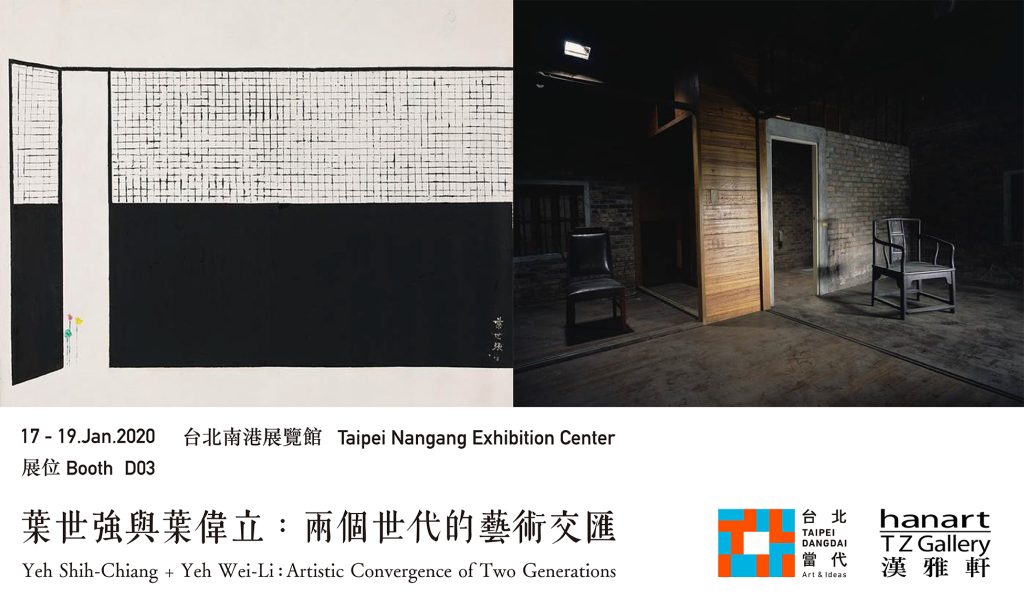
Yeh Shih-Chiang + Yeh Wei-Li: Artistic Convergence of Two Generations
Venue|Taipei Nangang Exhibition Center, Hall 1 (4th Floor)
No. 1, Jingmao 2nd Road, Nangang District, Taipei City
Booth|D03
VIP Preview (invitation only)|2pm-5pm, Thursday, 16 January
Vernissage (by invitation or advance ticket)|5pm-9pm, Thursday, 16 January
Public Opening|
11am-6pm, Friday, 17 January
11am-6pm, Saturday, 18 January
11am-5:30pm, Sunday, 19 January
Yeh Wei-Li’s “on-site archeology” turns artistic practice into research methodology. Through imaginative engagement he breathes new life into the “historical remains” of the life and art of Yeh Shih-Chiang (1926-2012). The reconstruction of Yeh Shih-Chiang’s former home in Shuinandong into a “residence museum” will be completed in the middle of this year. It is while living in this house, located in an old gold mining village at the foot of Mt Jiufeng and looking east towards the Pacific Ocean and Guishan Island, that Yeh Shih-Chiang developed his artistic conception that was to inform his creative work in the second half of his long life. This former residence of Yeh Shih-Chiang will now become a cultural and geomantic pulse point in the northeastern corner of Taiwan.
A major new publication on the project, Yeh Shih-Chiang + Yeh Wei-Li, will be launched at the Art Fair. The transmission of artistic illumination between generations is the creative methodology Yeh Wei-li uses in exploring the cycles of history and the operating mechanisms of social change.
Yeh Shih-Chiang was born in 1926 into a scholarly family in Shaoguan, Guangdong Province, China. During his student years at the Guangzhou College of Art, Yeh was granted permission by the influential artist Gao Jianfu, then Principal of the College, to take leave from his studies and set out on an adventure to travel and sketch along the way. With the intensification and spread of China’s Civil War, Yeh was forced to abort his plans and redirect his route to Taiwan. Unexpectedly, Yeh became stranded in Taiwan at the end of the war, when travel between Taiwan and the mainland was cut off. During his first few years in Taiwan, Yeh studied art at the Taiwan Provincial Teachers’ College (now National Taiwan Normal University) in Taipei. Depressed by his isolation from his homeland, Yeh grew increasingly reclusive and secluded himself in the countryside, where he lived a simple, ascetic life, practicing Zen Buddhism, teaching and painting. Gradually Yeh planted both creative and spiritual roots for himself in Taiwan, and every aspect of his daily activities was informed by a conscious awareness of the ideal of inner cultivation shared by both the Chinese literati and Zen traditions.
Contemporary artist Yeh Wei-Li was born in Taiwan in 1971. Since 2015, he has been engaged in a process of gradually and painstakingly excavating the history and environments of Yeh Shih-Chiang’s life as a means of understanding the personal and creative archaeology of the artist himself. His journey has taken him from Yeh Shih-Chiang’s abandoned residence in the remote village of Wan Tong in Xindian County to the master’s former home in the northeastern seacoast town of Shuinandong, on a path to unearth and re-examine the traces of Yeh Shih-Chiang’s world. Yeh Wei-Li’s series of photographic works taken over this period reveals a process akin to preparing and plowing the soil, planting the seeds and waiting patiently for them to grow, without expectation, until suddenly a new kind of illumination appears. In 2019 Yeh Wei-Li began to build wooden frames for Yeh Shih-Chiang’s oil paintings, as an act of homage to the master and a way of creating new possible perspectives through which to approach his works.

Press Enquiries
E. hanart@hanart.com
T. +(852) 2526 9019
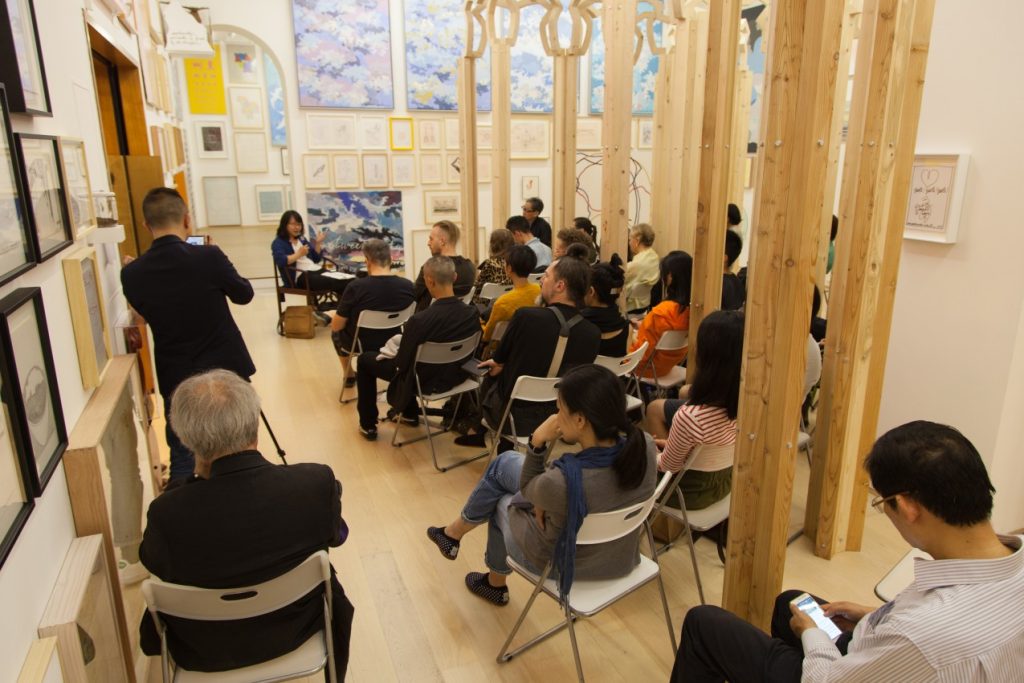
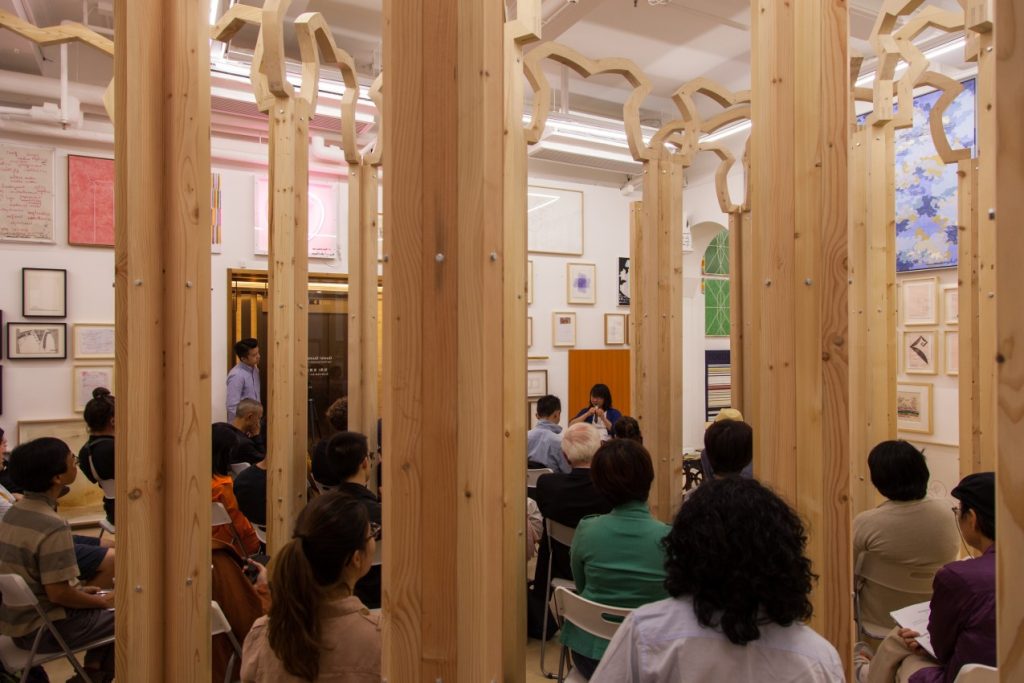
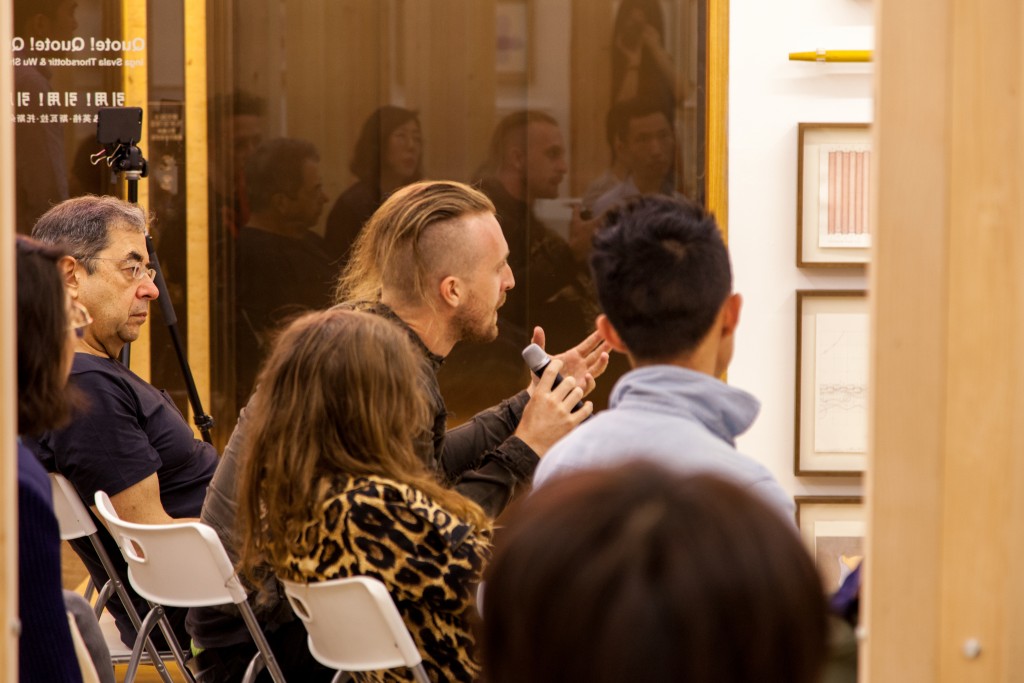
A Special Talk Co-presented by Hanart TZ Gallery and Inter-Asia School
“The Question Concerning Technology in China An Essay in Cosmotechnics”
by YUK HUI

26/04/2018 (THURSDAY)
Talk 6:00-7:00pm
Q&A 7:00-7:30pm
VENUE:
Hanart TZ Gallery
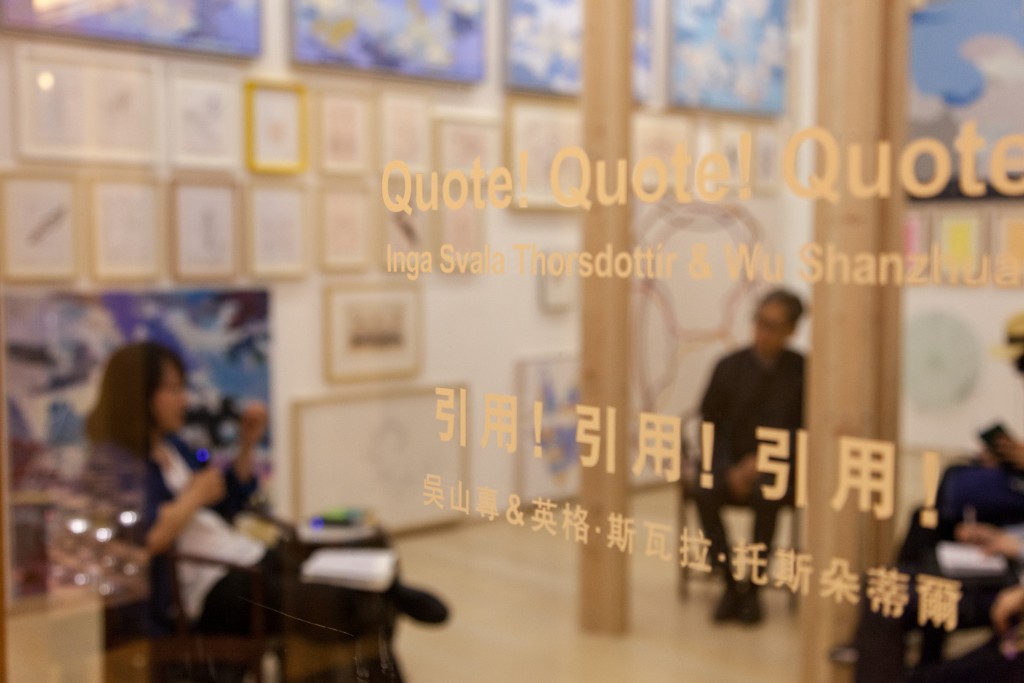
In the “Constellation Forest”
by Inga Svala Thorsdottir and Wu Shanzhuan
First Come, First Served
Wine and Drinks Served Throughout!
In The Question Concerning Technology in China: An Essay in Cosmotechnics published in December 2016, Yuk Hui questions the limit of the concept of technics in the 20th century philosophy of technology and proposes to re-open the question of technology according to what he terms cosmotechnics, which tends to go beyond the discourses limited to the Greek technē and modern technology. In this book he carries out a systematic historical survey of Chinese thought in comparison to the antique philosophy in Europe tries to understand why there is no systematic thinking of technics in Chinese thought. He attempts to construct a technological thought in China from two categories Qi and Dao, and suggests how it may contribute to the current debate on the global technological acceleration.
Yuk Hui is currently is associate lecturer at the institute of philosophy and art (IPK) and researcher at the Institute for Culture and Aesthetics of Media (ICAM) at the Leuphana University Lüneburg; he is also a visiting professor at the China Academy of Art. Previous to that, he was a postdoctoral researcher at the Institute for Research and Innovation of the Centre Pompidou in Paris and a visiting scientist at the Deutsche Telekom Laboratories in Berlin. He published on philosophy of technology and media in periodicals such as Research in Phenomenology, Metaphilosophy, Cahiers Simondon, Deleuze Studies, Techné among many others. He is co-editor of 30 Years after Les Immatériaux: Art, Science and Theory (2015), author of On the Existence of Digital Objects (University of Minnesota Press, 2016) and The Question Concerning Technology in China -An Essay in Cosmotechnics (Urbanomic, 2016), he is completing a new monograph titled Recursivity and Contingency (forthcoming 2019).





ILLUMINATED PRESENCE
Yeh Wei-Li: Interpretive+ Yeh Shih-Chiang
Booth 825, Pier 94, 711 12th Avenue at 55th Street, New York City
The project brings together photography-installation artist Yeh Wei-Li (b.1971) and late master painter Yeh Shih-Chiang (1926-2012). One part of this project was shown at the recent Taipei International Biennale 2016, and another detail was selected for the Slovenia International Triennial of Contemporary Art in 2016.
Yeh Wei-Li’s “on-site archeology” turns artistic practice into methodology of research. Through imaginative engagement he breathes new life into “historical remains” of Yeh Shih-Chiang’s life and art. The project includes a physical renovation of the older master’s abandoned residence, and inventive interpretation of his archive and “relics”. In so doing, he transformed the spirit and atmosphere of the world inhabited by Yeh Shih-Chiang into a physical experience in the here and now. Yeh Wei-Li has now developed this work into an on-going long term project for the foreseeable future.
In his lifetime the reclusive Yeh Shih-Chiang (1926-2012) was widely known for his enigmatic presence and uncompromising character. He rejected the academic art institution, refused compromise between art and society, and rejected all gain from art. In his refusals, he elevated art into an uncorrupted faith.
Of this on-going project of creativity and interpretation, Yeh Wei-Li said: “It is a daunting task to excavate ‘Greatness’…it propels one forward, in continuum, without knowing; endless questions arise, they beckon, and you dig, you mine deeper, you surrender, then enter subterranea where magic overflows…”
Yeh Wei-Li utilizes his customary approach of gradualness and penetrating observation over extended periods of time, to depict the slow mining of the remains of things used by the old master and their eventual transformation. It is precisely this extensive labor of the hand and unflinching spirit and belief in what is necessary to achieve lasting presence and memory of places and a life lived that binds the two artists’ works together. Through Yeh Wei-Li’s installation and time-based photographic tableaus is constructed a layered dialogue with the elder artist that elucidates the two corresponding lives and practices, while illuminating and giving sense to both.
Press Enquiries
E. hanart@hanart.com
T. +(852) 2526 9019
Hanart TZ Gallery is honoured to host Luohan Tang Collection’s special selection of exquisite antique lacquer furniture together with Zheng Li’s distinctive shanshui (landscape) paintings at our current solo exhibition “Zheng Li : Reflections of the Classical Garden”.
Gardens mirror Chinese culture. In the gardens are embedded the poetry, painting, architecture, calligraphy and the many important concepts that reflect Chinese spirituality and philosophy. In their turn, the Chinese arts, including the high furniture art, are mirrors for gardens, from their landscapes to symbolic single elements such as rocks or flowers. A refined example in this exhibition, is a single small red cinnabar lacquer cabinet of the early Qing dynasty, where ladies of the gentry enjoy their leisure time in a luxuriant garden. On a pair of important cabinets of Kangxi period (1661-1722), scenes inlaid with precious materials and hardstones illustrate a scholar’s life in his garden.
Gardens are a place for man to experience not only his relationship with the Natural world, also with the Nature of his own Self. In Zheng Li’s wonderful paintings, we can imagine that it is the same scholar who reappears or disappears in the garden scenes: here he is waiting for his servant to prepare the tea, while the tea utensils lie forgotten on some garden stones. And on the opposite painting, he has perhaps just left his studio, where his books are waiting for him to return, neatly set on a deserted luohan daybed. The melancholy mood of the paintings does not become mired in regretful visions of a time long past. Like the scenes on the cabinets which have gently come down to us, they are proposals to those who would dare to give them a free, open-minded glance.
As much as Zheng Li’s work is powerfully rooted in the tradition which the lacquer pieces exemplify, his personal and contemporary style help to open a new vision in those antique furniture pieces, which speaks to the ambition of many and the dreams of others among our contemporaries.
This cooperation is a wonderful chance to show the communion between artists separated by centuries in a playful and elegant manner. Indeed, visiting this exhibition, you might find yourself locked in a multi-tiered game of reflections, mesmerized by a threatening idea of eternity and most importantly enjoy looking for the many echoes resonating between these walls.
Press Enquiries
E. hanart@hanart.com
T. +(852) 2526 9019
Moderna galerija (MG+), Museum of Contemporary Art (+MSUM), Ljubljana, Slovenia
Beyond the Globe | 8th Triennial of Contemporary Art – U3
Curator: Boris Groys

Opening: 3 June 2016 at 8 p.m., Moderna Galerija
Venues: Moderna galerija (MG+), Museum of Contemporary Art (+MSUM) Ground Floor, Reactor Center Podgorica(Podgorica pri Ljubljani)
The exhibition presents many possibilities for the artistic exploration of the topic at hand: the connection between artistic and scientific imagination, the cosmos as analysis of sci-fi culture, perspectives of corporeal immortality and critique of contemporary technology. Slovenia’s art and artistic culture has always been particularly open to the universalist perspective. Already the architecture of Jože Plečnik signalled a desire to find a point of contact not only with world history but also with the mystical and mythical components of cosmic life – and at the same time to do so in an absolutely modern way. One cannot overlook the attachment of many Slovene artists, including many younger artists, to the utopian vision of Malevich and, in general, the early Russian avant-garde. This vision still informs many Slovene art practices – especially when it is referenced in a critical, ironic, or absurdist way.
The 8th edition of U3 brings an important change: it takes the exhibition outside the national framework. The new concept of U3 focuses on a dialogue between Slovene space and other contexts that are relevant for it. In this it follow the good practice of certain established “peripheral” biennials that focus on their specific time and place and function as a platform for produced meanings and contents with long-term, positive effects on their spaces.
For more details and images:
https://www.facebook.com/Hanart.TZ.Gallery/photos/?tab=album&album_id=1082604535133096
“Yaji Garden: Art Under the Sky”: a project in 4 parts.
Curators: CHANG Tsong-Zung, GAO Shiming
A.“Mountain and Water”
video (12 minutes)Artist (Garden Design): YE FangVideo: YANG Kai, GUO Yilin, Photography: Camille CHEN 陳雪, Sound: ZENG Yongqiang 曾永強

The Yaji Garden is both a garden for art gathering and domestic pleasure; its aesthetics is based on the same principle as the art of “mountain and water” painting (landscape). Artist YE Fang is a landscape painter affiliated with the Suzhou Painting Academy, and a specialist in classical gardens.
B.“Story of the Stone: Chiseling At Emptiness”
5 paper scrolls and one papier mâché sculpture, displayed as a constellation.5 paper scrolls (Right to Left): CAO Xiaoyang, LEUNG Kui-ting, LIN Haizhong, WANG Dongling, CHIU Kwong-chiuPapier mâché sculpture: XU Longsen

“Story of the Stone: Chiseling At Emptiness“ Concept by CHIU Kwong Chiu
Emptiness is not Void; it is the realm of potentiality. The Stone, or a drawing of the stone, emerges from emptiness to bring to life an ‘aesthetic realm’ by becoming part of a cosmos. A stone can merge with other stones to form a majestic mountain, or remain anonymous in the wilderness. Legend has it that the universe was formed when the goddess Nu Wo mended Heaven with a five-colour stone.
Paper comes from wood, a growing material that complements and ‘adds’ to the potentiality of Emptiness. The Stone represents the condensation of matter; its presence ‘reduces’ the potentiality of Emptiness. The calligraphic line draws the Stone as well as the Word; the line untangled undoes both the Stone and the calligraphic Word. In this constellation, scrolls, stones and ‘word-knots’ come together in various states of potentiality.
C.”Illuminated Presence”
An installation consisting of one painting, 3 photographs and 2 vitrines.
Artist (photography and installation): YEH Wei-liArtist (painting): YEH Shi-Chiang (1926-2012)

2008 Ink on Paper 136 x 420 cm


YEH Wei-li believes the practice of photography should be an active engagement with its subject matter. For this project he has renovated the old master’s derelict studio in order to bring it back to life for a series of photographs. He also selects and archives objects from the painter’s “relics” to give him a new “museum” presence.
D.”Eaves Dropping on A Tree Spirit”
Scroll in Moon Palace paper (20-meter roll)
Artist: Ali VAN


Artist Statement:
Les Titres De Vie
On Something like this
something about the shards we cast
away with memories
a primitive eulogy, a collection of epitaphs
something about the “life span of things”the wit of all things recorded and kept
to live out their functional lives –
you start at the backdoor, guided by the beat of 8 sun men folk rusty clarity canvasing shoes to mount on hip back weight of your bark, your rope entangle, your archi-agri-cultural song. there is no water yet but soil and debris of new made man trees, pillars in tang, lacquer ready. you sense the south, the yin around you, yang sequestered to family air room, heirlooms upstairs. there is a man to the west resting, his force to guard change, practice, precise manifestation. the east marks market, meditation, sceptique neighbours watching you walk. your refuge in dim light, north where blossoms slip like silk to write eyes on pine. body silent, stirring, -speaking in-betweens. beyond the maingate we let your bike break root of rubber tree.
The Body of Confucius: Installation #2 Re-making the Confucian Rites – Capping Ceremony
Video in 3-screen projection, 15 minutes
Authors: Chang Tsong-Zung, Jeffrey Shaw
Academic Host: Peng Lin, Tsinghua University Research Center of Chinese Rites
Video production: CityU School of Creative Media, Paul Nichola
Project initiators and producers Re-making of the Confucian Rites: Jia Li Hall, Tsinghua University Research Center of Chinese Rites

The traditional cosmology and system of knowledge known as li, usually translated as Confucian Rites, bore the brunt of critical attacks by modern reformers at the beginning of the 20th century. To the modern Chinese, li is now one of the most remote and unintelligible aspects of China’s cultural past. And yet li has always lied at the heart of China’s civilisational order: In pre-modern days, relations at all levels of society were informed by an intuitive understanding of li: whether it be court officials or village neighbours, literate or illiterate. As a cosmology, li has fostered the social and personal cultivation that allow the Chinese person to navigate the world. Any discussion of the ‘Chinese spirit’ would be incomplete if it fails to include the system of li.
Li research provides a conceptual framework for unwrapping concepts surrounding that area of experience and knowledge that in modern times has mainly been framed in Western terms of ‘art’ (yi shu) and ‘aesthetics’ (shen mei). As a system of awareness and ‘practice’, li offers a barometer for gauging the rapid changes that are taking place in Chinese people’s sensibilities in the course of modernisation, especially in terms of their physical body and their ‘livingness’. The tradition of li also highlights the potential of art as a harmonising force in attuning new sensibilities to society – a significant mission of art in view of the fluidity of social relations in contemporary times.

Confucian (li) is a civilizational framework that covers the realms of aesthetics, ethics and ideology. It is also a technique of the body, a skill that can be learnt and inscribed. ‘Re-making’ Confucian li is relevant today as an important alternative system of knowledge, and a shining historical example of ‘aesthetics as politics’ (not politicized aesthetics). Research projects we are undertaking address the following related issues:
1. The ‘archaeology of the modern’. Becoming ‘modern’ implies a radically revised regime of the body, and within this regime is embedded the ideology of the Chinese ‘modern’. A crucial question about Chinese modernity is: How was the ‘Chinese modern body’ constructed? What process did it take?
2. How does social order manifest itself physically in the social body? Asking the question in reverse: How does a Self come into its own through claiming a social-body as its own? What technique/skill must the Self acquire to negotiate with society, and maintain an appropriate distance from the State at the same time?
3. Within a State system, how might a social-body such as li be deployed for some form of tribal self-determination? (i.e. as a means for resistance and creativity?) How might a technique based on the Self become a national/international language of the social-body?